
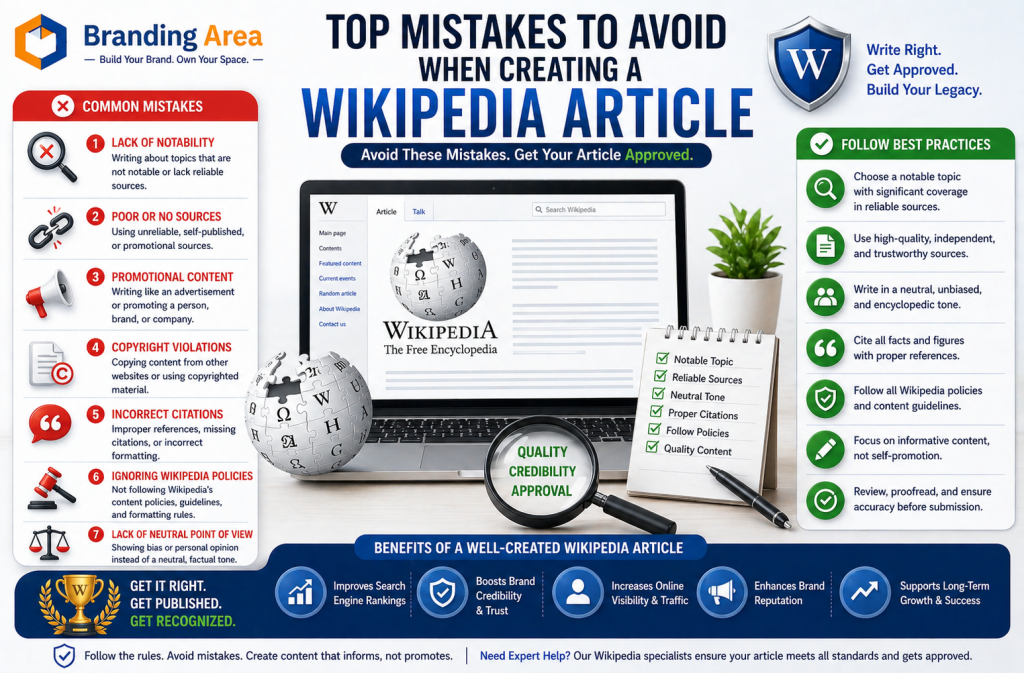
Wikipedia article creation helps spread knowledge to everyone around the world, you need to both understand their rules and handle several challenges. First-time contributors frequently make simple but serious mistakes that end up causing their work to be taken down.
You can’t make your Wikipedia articles shine unless you recognize and fix the usual mistakes writers make during research and writing. When you write according to Wikipedia’s requirements, you create content people can trust, confirm, and learn from. This guide will show you the biggest mistakes people make when making Wikipedia articles.
Not Following Wikipedia’s Notability Guidelines
The first of the most frequent mistakes is a failure to check whether the article’s topic complies with Wikipedia’s notability criteria. Wikipedia is an encyclopedia containing only important and ample information from third-party sources. If the subject doesn’t correspond to these standards, the article may be put up for deletion.
Solution: Before writing an article, always check the notability guidelines and ensure enough references from reliable and independent sources to support the topic. These sources should not be promotional or self-published either. Instead, they should be from reliable sources. It may include newspapers, academic journals, or books only.
Engaging in Original Research
It is notable that any original research is prohibited at Wikipedia. Any element in the article of Wikipedia must be traced back to the source where the information was obtained, and the information must be verifiable. Some newcomers attempt to include new data that are not discussed in the prior works in order to introduce different angles.
Solution: It’s probably even more preferable to just remain within the general range of other published research and ONLY from journals. Do not impose your opinion, analysis,or research.hus, the purpose is to provide a balanced picture of the state of the knowledge.
Lack of Neutrality
Two things all the articles must conform to that they must all be written from an NPOV, as per Wikipedia policy. Writers should know that writing an article with a negative or positive attitude toward the chosen topic results in the banning/blocking of the article.
Solution: The article must not be biased in any way. Give all the details that are required, and it is a strict no-no to use any brand names. Wikipedia articles should not be a commercial or an essay.
No Information from Credible Sources
Any content provided in the Wikipedia articles should be backed by reference from other reliable sources. The first mistake is to omit such or use wrong sources. This in most cases results in the complete elimination of the content or even the article in question.
Solution: One more thing that should be a rule for the writer: he/she must always use only reliable sources that are easy to verify. When citing facts, claims, or statements, be sure to check all the above. In addition, publications from scholarly journals, newspapers, and magazines, as well as books from scholarly publishing houses, are also credible.
Refusal to Use Appropriate Citation and Bibliography
Even where credible sources are used, improper citation methods could cause a lot of damage to the credibility of the article. Citation standards are important to not confuse the content or have the content owner delete it.
Solution: When citing a source, use Wikipedia formatting and citation tools to make your referential information appropriate. When citing your ssources, use templates to ensure that your references are as clear and consistent as possible in the article.
Not Using Proper Citations and References
Even when reliable sources are used, improper citations can undermine the credibility of your article. Failing to follow citation standards can result in confusion or content removal.
Solution: Use Wikipedia’s citation tools to format and place your references properly. Use templates for citation to make your references clear and consistent throughout the article.
Creating Promotional or Self-Promotional Content
Some individuals attempt to create Wikipedia articles about themselves, their businesses, or their products. This often leads to a conflict of interest (COI) and violates Wikipedia’s guidelines. Articles that come across as promotional are frequently flagged and deleted.
Solution: If you have a connection to the article’s subject, it’s best to avoid writing it yourself. Instead, provide factual, neutral information through reliable sources. If you choose to write an article, focus on maintaining a neutral tone and avoid any promotional language or content.
Overly Complex or Technical Language
Another mistake is using overly complex or technical language that may confuse general readers. Overloading an article with jargon can make it difficult for the average person to understand.
Solution: Aim for clear, simple language. If you must use technical terms, explain them in a way that a non-specialist can understand. Remember, Wikipedia is for a general audience.
Failure to Maintain Article Updates
Articles can start right but fall behind as time passes, with old facts replaced by new ones. Not regularly updating our work makes articles outdated and untrustworthy with old information.
Solution: Continuously improve the article by incorporating new and confirmed details from tested sources. Review and refresh the article’s content to align it with recent updates.
Ending Note
If you avoid these frequent Wikipedia article creation flaws, you help yourself get the article accepted rather than having it turned down. You need to stick to Wikipedia rules exactly, keep information balanced and proof your sources, and back up what you write with good references.
Writing an article that follows Wikipedia rules helps both Wikipedia grow and your brand get noticed. Use experienced experts to create your Wikipedia pages to make your digital footprint more powerful.
Let’s take help from the Branding Area by making Wikipedia articles that shine. The Branding Area is your partner for making Wikipedia articles that impress and last.